|
Överhogdal tapestries are some of Europe’s most significant cultural treasures. They are dated to the transition period between pagan and Christian times and thus belongs to the oldest textiles that have been preserved to our time. Since Paul Jonze made his discovery in 1910, many researchers has tackled the difficult task of trying to interpret the weaver’s narrative content. It has been compared to other preserved pictorial representations, Norse sagas, Christian symbolism, read in fertility rites, wedding trips, antique sacrificial cult. It's exciting performance worlds we enter into when following these interpretations!
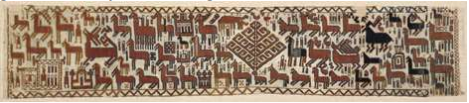
How tapestries ended up in the church store-shed is a fascinating story in itself.
Kindly see below tale.
Source; the script of “The Överhogdals Weaves, Compiled by Ulla Oscarsson.
The tapestry was neither rolled up nor hanging, but lay like a large rag crumpled up on the
floor to the roght of the door. It was among dusty mouldings and other old bites of interior
decoration, old round timber of birch, winegless angels and other varied rubbish that is
collected over the years. Wheither it had lain in the wooden store-shed long or not could not
been found out of….
When Jonze found the tapestries it were sewn into a large quilt. But the parts were missing in
the right corner. Helena Öberg from association for jämtands handicrafts, therefore traveled
the following year to the village Överhogdal to try to find the missing parts. In the afternoon
of3 rd December 1911 She arrived at the postoffice in the village Överhogdal. She met an old
man who asked the purpose of her visit and she replyed jokingly, that she was looking for yje
missing parts of the taspetry. To this he replied thtat if she was to accompany him she would
be given a piece of the tapestry. They went to a small cottage and when entering the house there
was only a 5 year old girl there who, when asked where her dolls blanket was, pointed to a
cupboard and said, “in their” Meanwhite the child mother has entered and she took the dolls
blanket out of the cupboard and it turned out to be the piece that was missing. The child did
not want to part from her blanket and began to cry. Ms Helena then gave her two krones and
promised her a new blanket, a promise she later kept…..
Designer Åse Öjbro, founder of Öjbro Vantfabrik, have created wearable art with mittens as her starting point. Åse worked as a painter in many years before she decided to express herself in wool. Åse has created this pattern as her interpretation of the “Yggdrasil world tree” a illustrated pattern on the front of the mitten showing the world tree all framed with humans and the horses Sleipnir & Rimfaxe with the bird harbinger of Armageddon and finally above everything the cross at the top that symbolizes the later Christianity. The cuff has a two colored rib.
Personally I was so moved by Miss Helena's story of how the little girl so understandingly gave away here blanket. A little girl's Christian Action for a larger context. And the fact that Sweden has such cultural treasures.
|

Exactly how long mittens have
been knitted in Scandinavia is
unclear, but there are preserved
mitten fragments dating back
to as early as the 13th century.
* This pattern is inspired by the
Vikings and the Yggdrasil the
world tree and then we have
colored it in traditional colors.
Öjbro glove factory is
passionate about passing on our
different knitting traditions to
other people. |